
Honeywell Air Duct Cleaning in Lake Jeanette: A Homeowner’s Guide
A Honeywell electronic air cleaner with a freshly washed filter can still be pushing settled debris out of duct walls the filter never touches. The two systems handle different halves of the same problem, and most Lake Jeanette homeowners who call us about filtration upgrades don’t realize it until we open a register and show them the buildup downstream of a working unit. Here’s the boundary drawn clearly: what Honeywell equipment does, what mechanical cleaning does, and how the two should sequence together.
Where Honeywell Systems Intercept Particles vs. Where Debris Actually Settles
Honeywell air quality equipment works at the air handler. A whole-home media filter, an electronic air cleaner, or a UV-C lamp all sit in or near the return plenum and treat the air as it passes through. Airborne particles get captured there. Settled debris on duct walls is a different matter entirely, because it isn’t moving through the filter as air.
Picture the duct run as a hallway. Air moves through the middle. The walls collect dust, hair, pet dander, and construction grit that the airstream never lifts once it has settled and adhered. A filter, even a good one, only sees what’s still in the air by the time it reaches the handler. Filter upgrades are real improvement, and we install and service them. But they clean air in transit, not the surfaces the air travels past.
In Lake Jeanette, that distinction matters most in homes with flex duct runs and long returns. Those are the places we find the heaviest wall adhesion and the least filter benefit, because the settled material is out at the far runs, not at the unit. A filter’s job and a cleaning’s job overlap less than product literature implies.
Why Maintenance Schedules for Filtration and Duct Cleaning Are Not Interchangeable
A homeowner who keeps up with Honeywell filter changes on schedule may conclude their ducts are clean. They’re not. Filter maintenance keeps the equipment working and protects the blower and coil. Duct cleaning removes accumulated material from duct interiors. The intervals answer different questions.
- Filter changes: driven by pressure drop across the media. Load a filter faster and you change it faster. It doesn’t tell you what’s on the walls.
- UV-C lamp service: lamp output falls over its rated life. Replacing on schedule keeps treatment consistent; it doesn’t remove settled debris.
- Duct cleaning intervals: driven by what’s IN the duct, not by what the filter is doing. Visible debris at registers, musty odor, uneven airflow, or a recent renovation are the real signals.
We’ve talked to Lake Jeanette homeowners who are diligent about filtration and still have visible dust fallout on furniture. That’s the mismatch in action: the air is being filtered, but the source is behind the register. The two schedules run in parallel. Neither replaces the other.
What Proper Duct Cleaning Looks Like Before You Add a Honeywell System
If you’re planning to install or upgrade a Honeywell filtration or UV system, the ducts should be cleaned first. Installing new equipment on top of a dirty system means the new filter loads quickly with material that should have been removed, and the UV lamp is downstream of debris it can’t address.
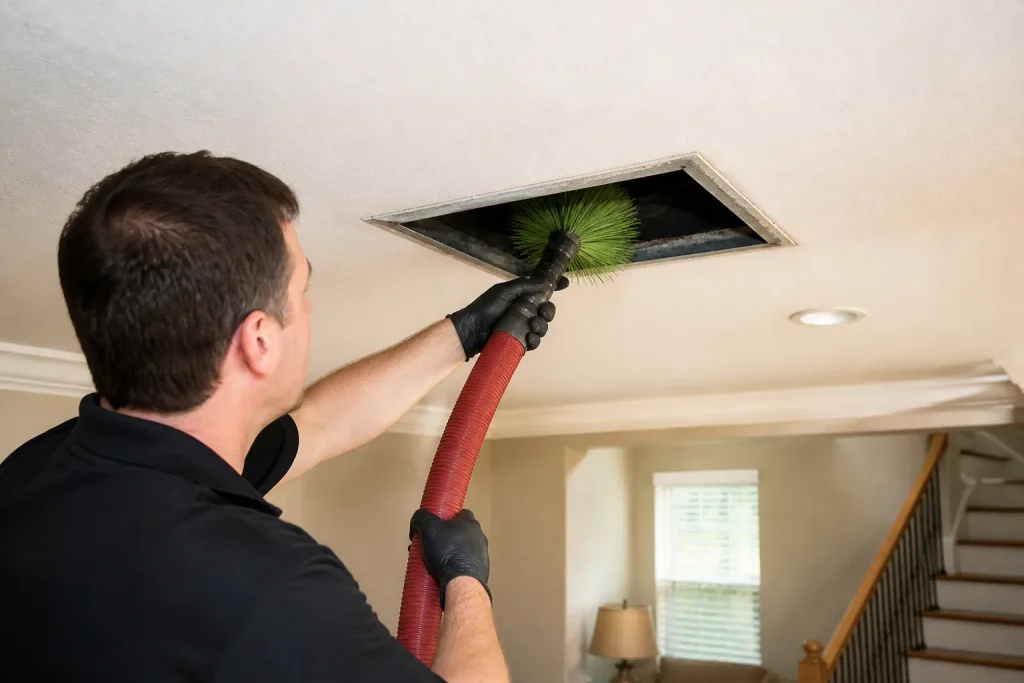
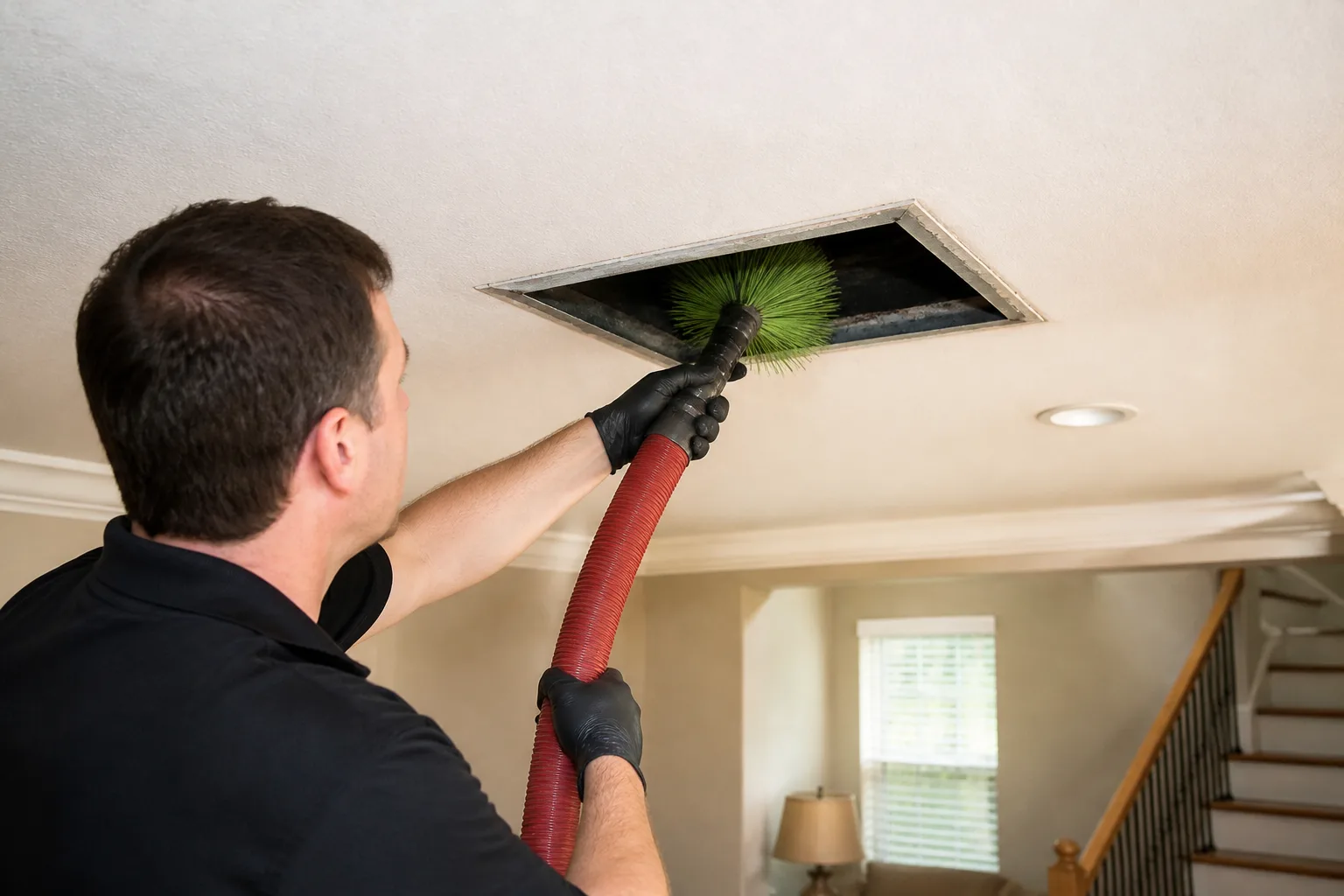
Proper cleaning uses contact methods and HEPA-rated extraction. We use Rotobrush brushes that physically agitate duct walls while Nikro HEPA-rated vacuums capture what’s dislodged, so material leaves the system instead of being redistributed. That’s the same equipment pattern remediation contractors use, and it matters when the concern is fine particulate or post-construction dust.
- Inspect the register-to-handler layout and note flex runs, transitions, and any visible debris.
- Contact-clean accessible runs with brushes while HEPA extraction runs simultaneously.
- Verify with before-and-after photos of the homeowner’s own ducts.
- Install or service the Honeywell equipment on a clean system, then set the maintenance cadence.
The order matters. Cleaning first, equipment second, maintenance schedule third. Skipping the first step wastes the other two.
Sequencing UV Sanitization and Duct Cleaning: Three Mistakes to Avoid
Adding UV-C sanitization to a duct cleaning is a common Lake Jeanette request, especially after a musty odor complaint or a moisture issue. It can work well. The mistakes tend to show up in how the two steps are sequenced and how the chemicals are chosen.
Sequencing: sanitize after the mechanical cleaning, not before. A sanitizer applied to a duct with heavy settled debris has to work around the debris, and the debris remains afterward. Clean, then treat.
Chemical compatibility: some sanitizing products don’t play well with certain filter media, seals, or electronic air cleaner components. Spraying broadly near a Honeywell electronic cell without accounting for the components is the kind of shortcut that shortens the equipment’s life. We choose Guardsman-grade products that are selected for the surfaces they’ll contact.
Dwell time: a treatment sprayed and immediately extracted isn’t doing what it’s supposed to. Dwell time is part of the process, and skipping it is a quiet way to skip the result. When a company rushes this step, the invoice says sanitized but the duct says otherwise. It’s the least visible failure in the whole job.
Using Honeywell Performance Data as an Indirect Diagnostic for Duct Condition
Your Honeywell system already collects useful information about the house, even if it wasn’t installed for that purpose. Two readings are worth watching in Lake Jeanette homes: filter loading rate and humidity.
Filter loading rate: a filter that loads faster than its normal interval suggests particles are reaching it that shouldn’t be. Often that’s because debris is being disturbed upstream, or because the system is pulling from a dirty return. It doesn’t prove ducts are dirty, but a sudden change is a signal worth investigating.
Humidity readings: if the indoor humidity in a Lake Jeanette home is running high, or if it varies room to room, that’s a moisture signal. Moisture plus settled dust is the combination that produces musty odor and microbial growth. An Aprilaire or Honeywell humidity upgrade can help controller humidity, but it doesn’t remove material already present. High humidity plus musty smell is a prompt to have the ducts inspected, not just the humidity addressed.
Neither reading is a substitute for a physical inspection. They’re indirect clues that tell you when to look.
How Honeywell Equipment Fits With a Full Cleaning and Repair Visit
Filtration and UV-C are the treatment end of indoor air quality. Duct cleaning is the removal end. Around both sit repair and sealing, dryer vent clearing, and HVAC cleaning, and a house with a musty odor or uneven airflow problem usually needs more than one of these looked at in the same visit.
Loose duct connections and leaking seams pull unconditioned air into the system and undo a filter’s work. A dryer vent that’s been neglected for years is a separate concern with its own safety weight. In Lake Jeanette, we treat these as one indoor air quality picture rather than independent service tickets, because that’s how a house actually behaves. From duct to dryer vent, the parts affect each other.
If you’d rather not take on the diagnostic work yourself, call (877) 792-7174. We answer 24/7, and estimates are free.
For a full picture of what we do, start with Air Duct Cleaning Lake Jeanette. If you’re focused on the cleaning itself, see air duct cleaning, and if the dryer has been running warm, dryer vent cleaning is the next stop. When the handler or coil also needs attention, we handle HVAC cleaning in the same visit.
When to Call a Pro
Call a professional when you see visible debris at the registers, notice musty odor that returns after a filter change, feel uneven airflow room to room, or are planning a Honeywell equipment upgrade on a system that hasn’t been cleaned in years. Also call when the ducts themselves may be damaged, and when a UV or sanitizing step is being considered, since both involve equipment and sequencing decisions best made with a technician on site. Our technicians have up to 13 years of experience with these systems.
The Bottom Line
A Honeywell filtration or UV-C system improves the air at the handler. Duct cleaning removes what’s built up in the runs. Neither replaces the other, and the right order is clean first, equipment second, maintenance schedule third. Use filter loading rate and humidity readings as clues to when to look, not proof of what’s there. If you’re in Lake Jeanette and need help, Air Duct Cleaning Lake Jeanette offers free estimates – call (877) 792-7174. We answer 24/7. Fast dispatch from 7am to 7pm, Sunday through Friday.
Frequently Asked Questions
No. A Honeywell electronic air cleaner captures airborne particles at the handler, but settled debris on duct walls stays where it is. The two address different parts of the air quality problem. Call (877) 792-7174 for an inspection if you’re unsure which your home needs.
After. Mechanical cleaning removes the settled debris first, then sanitizing treats the cleaned surfaces with proper dwell time. Cleaning first gives the sanitizer a surface worth treating. Call (877) 792-7174 to talk through the sequencing for your system.
Not directly, but it’s a useful clue. A filter that loads faster than usual suggests particles are reaching it that shouldn’t be, which often means debris is being disturbed upstream. Use it as a reason to inspect, not a diagnosis. Call (877) 792-7174 for an exact quote on inspection and cleaning.
It depends on what’s in the duct, not a fixed calendar. Visible debris at registers, returning musty odor, uneven airflow, or a recent renovation are the real prompts. Homes with pets, allergies, or heavy filtration use often need it sooner. Call (877) 792-7174 for a free estimate.
Written by the team at Air Duct Cleaning Lake Jeanette.
Need Air Duct Cleaning Help?
Call Air Duct Cleaning Lake Jeanette - the local pro we connect you with is licensed and insured, here with fast help in Lake Jeanette.
(877) 792-7174